
OUR NEWSBlog

DPDPA in BFSI Sector: Compliance Strategy for Banks & NBFCs

DPDPA in BFSI Sector: Compliance Strategy for Banks & NBFCs

A customer opens a savings account. Within minutes, personal data moves across multiple environments. Aadhaar and PAN details are verified. Credit bureau checks are initiated. Data flows into the Core Banking System, document management platforms, mobile applications, risk analytics engines, and regulatory reporting frameworks. In an insurance company, underwriting teams access health information. In a...

DPDPA for Airlines: Compliance Strategy for Aviation Leaders

DPDPA for Airlines: Compliance Strategy for Aviation Leaders

At 3:10 AM, a passenger books a flight from Mumbai to Dubai. Within seconds, personal data travels across a booking portal, payment gateway, fraud detection engine, CRM, global distribution system (GDS), loyalty database, and airline operations control system. Before the flight even departs, passenger details may be shared with immigration authorities, airport operators, ground handling...

DPDPA in Education Sector: Compliance Guide

DPDPA in Education Sector: Compliance Guide

It usually starts with something small. A school collects admission forms containing a child’s name, address, Aadhaar number, parent details, medical history, and academic records. The data is stored in an ERP system. Teachers access it. Administrators download spreadsheets. IT teams back it up to the cloud. A third-party vendor manages the learning app. A...

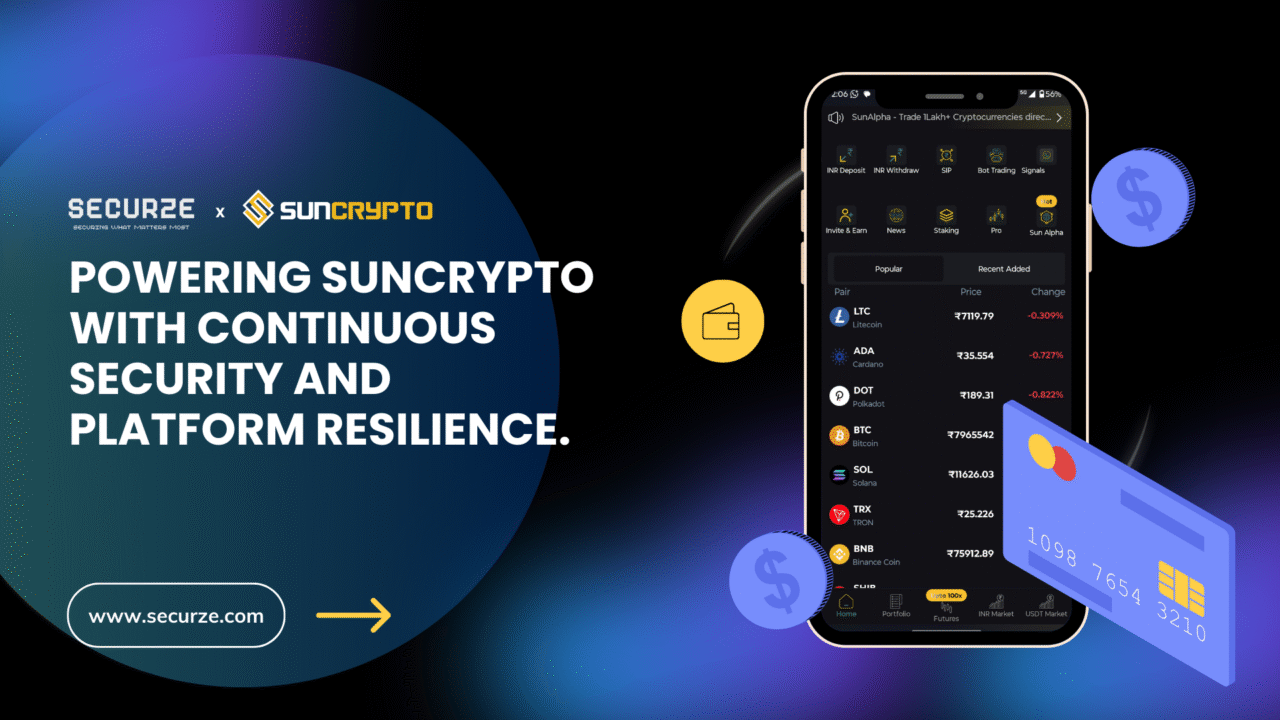
Securze and SunCrypto’s 3+ Years Strong Web3 Cyber Partnership

Securze and SunCrypto’s 3+ Years Strong Web3 Cyber Partnership

The Web3 industry continues its rapid evolution, bringing with it new forms of value exchange, decentralized business models, and high-velocity innovation. However, this growth is accompanied by increasingly complex and critical security challenges – from smart contract flaws and wallet compromises to cloud misconfigurations and exchange breaches. In this environment, robust cybersecurity is not just...

Web3 Security Threats (No One Talks About) – Part 2

Web3 Security Threats (No One Talks About) – Part 2

In Part 1 of this series, we explored how authentication flaws and logic errors can compromise Web3 platforms – from brute-force attacks bypassing two-factor authentication to IDOR vulnerabilities that lock users out of their own funds. Those vulnerabilities were dangerous, but they required some level of exploitation skill and understanding of API manipulation. What we’re...

Web3 Security Threats (No One Talks About) – Part 1

Web3 Security Threats (No One Talks About) – Part 1

After a year of pen-testing Web3 applications at Securze, we’ve seen patterns that most security discussions miss. While everyone focuses on smart contract vulnerabilities and consensus attacks, some of the most critical issues we’ve uncovered exist in places developers don’t expect. Throughout 2025, our team has assessed security across the Web3 ecosystem: crypto wallets managing...

The Future of Cybersecurity: End-to-End Protection with Securze & Fortinet

The Future of Cybersecurity: End-to-End Protection with Securze & Fortinet

Cybersecurity is no longer a nice-to-have. It’s survival. Every day, organisations are under siege — ransomware, insider threats, zero-days, phishing campaigns, and state-sponsored attacks are not just headlines, they’re business realities. At Securze, we’ve always believed in one thing: defense should be relentless, intelligent, and uncompromising. That’s why we are proud to join forces with...

DeepSeek: Data Breach Technical Walkthrough

DeepSeek: Data Breach Technical Walkthrough

In a recent security incident, DeepSeek, the new Chinese AI startup, suffered a significant data breach due to an unsecured ClickHouse database. This breach exposed over a million log entries, including sensitive information such as chat logs, API keys, backend service details, and operational metadata. Technical Walkthrough: Cause of the Breach The root cause of...

Understanding OAuth: Exploits, and Best Practices

OAuth (Open Authorization) is a widely adopted authorization framework that allows applications to grant limited access to their resources without exposing user credentials. OAuth allows users to authenticate third-party applications without sharing passwords, instead using tokens to authorize access to protected resources. While OAuth is a powerful and flexible authorization protocol, improper implementation can lead...